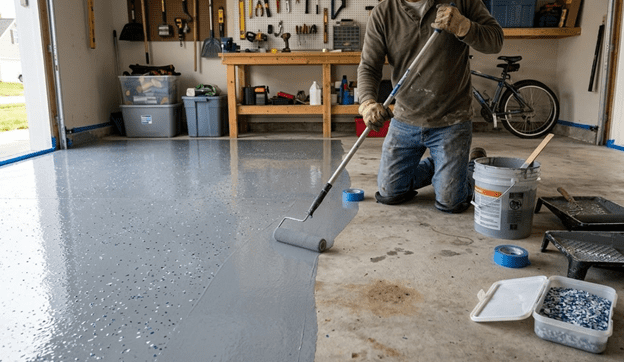
Walk into any large hardware store and you’ll find epoxy garage floor kits promising a showroom finish over a weekend. They look straightforward, the pricing seems reasonable, and the before-and-after photos on the packaging are convincing. But before you grab a roller and a tray, there are a few things worth knowing — because the gap between a DIY epoxy garage floor and a professionally installed epoxy coated garage floor is larger than most people expect.
What’s Actually Inside a DIY Epoxy Garage Floor Kit?
Most DIY kits contain a water-based, single-component formula marketed as epoxy paint for garage floor use. The word “epoxy” appears on the label, but the product is typically a latex enamel with a small percentage of epoxy resin blended in. That matters because:
- It doesn’t chemically bond to the concrete the way a true two-part garage floor epoxy does.
- It sits on top of the surface rather than penetrating and adhering at a molecular level.
- It’s more susceptible to peeling, bubbling, and hot tyre pick-up — a common frustration where the coating lifts when a warm tyre parks on it.
Genuine epoxy resin for garage floors uses a two-component system (Part A resin + Part B hardener) mixed immediately before application. This chemical reaction creates a hard, durable film that consumer kits rarely replicate.
The Surface Preparation Problem
Here’s where most DIY garage floor epoxy projects run into trouble, even when the product itself is decent. Proper adhesion requires the concrete to be profiled — meaning the surface must be opened up mechanically so the coating can bond into it.
Professional flooring installation companies near you use diamond grinders or shot blasters to achieve the correct surface profile. Most DIY guides suggest acid etching as an alternative, but:
- Acid etching is inconsistent — especially on sealed, painted, or contaminated concrete.
- If the floor has been previously coated (even lightly), acid alone won’t remove it.
- Moisture in the slab — a real issue in Florida — can cause adhesion failure within weeks if not properly tested and managed.
A peeling garage floor epoxy covering six months after installation isn’t just frustrating — it’s costly to remove and redo properly.
Where DIY Epoxy Garage Floor Kits Fall Short
Beyond adhesion, here’s an honest comparison of what you typically get with each approach:
Durability: Professional epoxy garage floor coatings, particularly those finished with a polyaspartic floor coating topcoat, are designed for vehicle traffic, chemical spills, and long-term wear. Most consumer kits have a lifespan of 1–3 years under normal use before visible degradation begins.
Appearance: Professional garage floor epoxy floors use broadcast flake systems, metallic pigments, and multi-layer build-ups that are difficult to replicate with a basic kit. The finish is simply not comparable.
UV Resistance: In Florida’s climate, UV exposure is a significant factor. Many standard epoxy paint garage floor products yellow or fade outdoors or in garages with natural light exposure. Polyaspartic topcoats used by professionals are UV-stable.
Warranty: A reputable flooring company will stand behind their work. DIY kits don’t come with installation warranties — if something goes wrong, you’re back to square one.
When Does DIY Make Sense?
DIY kits can be appropriate for low-traffic areas — a small storage room, a basement workshop corner, or a utility space where aesthetics and longevity aren’t priorities. For a main garage floor that sees daily vehicle use, tools, and foot traffic, the honest answer is that a professional epoxy coated garage floor will outlast and outperform a kit application by a considerable margin.
Get a Professional Epoxy Garage Floor Done Right
At Clever Coatings, we install professional-grade garage floor epoxy systems across Central Florida — properly prepared, properly applied, and finished to last. If you’re weighing up DIY versus professional, we’re happy to walk you through the options with zero pressure.
Get Your Free Instant Quote at clevercoatingsusa.com
Contact Us: clevercoatingsusa.com/contact-us/
📞 Call us: (407) 489-5256
✉️ Email: [email protected]
Frequently Asked Questions
1. Are DIY epoxy garage floor kits worth it?
For light-use areas with minimal traffic, a DIY kit can provide a short-term improvement. However, for a main garage floor subject to vehicles, chemicals, and daily use, a professionally installed garage floor epoxy system will significantly outperform a kit in terms of durability, appearance, and longevity.
2. Why does epoxy peel off garage floors?
The most common causes are insufficient surface preparation and moisture in the concrete slab. Without proper profiling (diamond grinding or shot blasting) and moisture testing, even a good epoxy floor coating can fail to bond correctly and begin to peel — especially under the heat and weight of vehicle tyres.
3. What is the difference between epoxy and polyaspartic floor coatings?
Epoxy resin for garage floors provides the strong, chemically bonded base layer. Polyaspartic floor coating is a fast-curing, UV-stable topcoat applied over the epoxy base. Together, they create a garage floor epoxy system that is more durable, scratch-resistant, and visually refined than either product used alone.
4. How long does professional epoxy floor coating take to install?
Most residential garage floor epoxy projects can be completed in one day by a professional crew. Curing time varies by product — polyaspartic topcoats allow light foot traffic within hours, with full vehicle use typically after 24 hours. Your installer will advise on specific timing for your chosen system.
5. Can I get epoxy garage floors in different colours and finishes?
Yes — professional epoxy garage floor installations offer a wide range of decorative options including solid colours, multi-colour flake broadcasts, metallic effects, and matte or gloss topcoats. The variety available through professional flooring installation companies far exceeds what you’ll find in a standard DIY kit.